
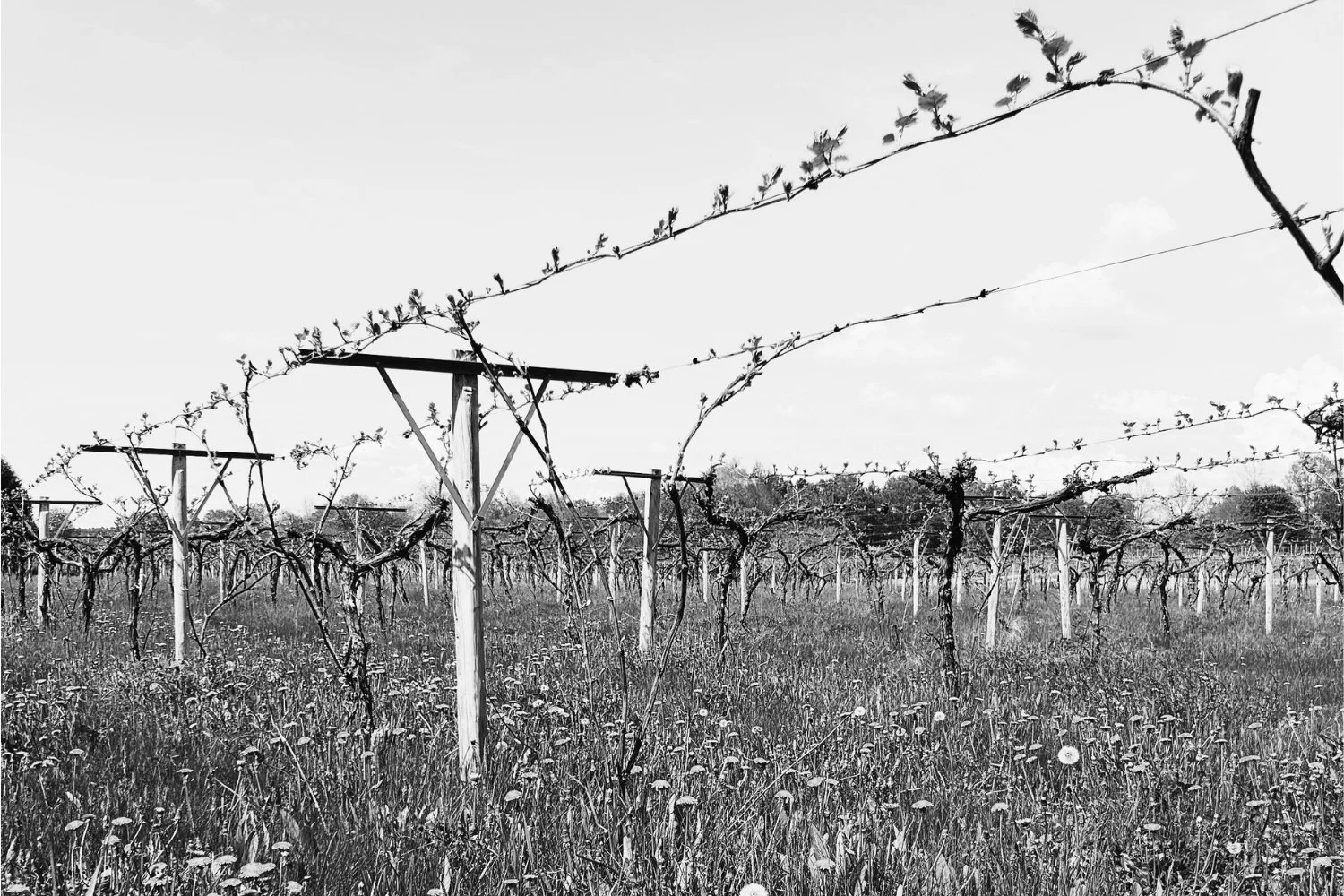
It’s hard to believe the first quarter of the year has come and gone. We’ve been spending the early days of spring in our favorite way: among the vines, enjoying the rising temperatures and watching the season’s colors give way from white to green. As the snow melts, pruning becomes a softer dance, suckers and ground shoots revealing themselves more freely, renewals becoming easier to identify. Our job becomes twofold: to select strong, healthy canes as the source of this year’s fruit, cutting everything else away, and to identify future trunks, or renewals, now just tender suckers peeking out from the base of the vine.
Since starting this chapter at Lincoln Peak, our number one focus in the vineyard has been on trunk renewal, drawing up new growth from the roots to replace old, diseased wood. Many of our vines are nearly 25 years old — long-lived by Vermont standards. Historically, the modus operandi was to remove all suckers so that the vines only needed to focus on ripening fruit. But without an eye to the future, we’ll lose many of our vines to cold damage or ubiquitous diseases like crown gall. Trunk renewal, then, is our greatest act of sustainability. To rip out and replant would not only be costly, but would erase a quarter century of root networks, of biological memory, of relationship to the land.
And so, during the winter, we carefully select our renewals, getting on our hands and knees in the snow, searching for the strongest cane able to withstand Vermont’s arctic chill. In the spring, we’ll clear the grass around this renewal, making sure it’s getting sun and air flow, and in the summer, we’ll tie up the new shoot, securing it to the trellis so that it may continue to grow into a healthy trunk. It’s an intimate thing, this act of renewal, tenderly nurturing a new life for this beautiful, wizened plant.
While we’ve been busy selecting our renewals, we’ve also been continuing the oh-so important work of pruning. As winegrowers, there are only so many levers we can pull to impact the trajectory of the vineyard—pruning is without a doubt the most consequential. A single cut that we make this winter will be impactful five, even ten years from now. The question is certainly where to cut, but also when.
We practice delayed pruning, whereby we prune in the opposite order in which the vines wake up. The theory is that pruning the vine just as it’s stirring from hibernation, it becomes distracted, focusing on healing the wound rather than creating new growth. In Vermont, where temperatures are wont to nosedive on a whim and spring frost is a constant fear, delaying budbreak by even a few days can save our vines from bud damage—and save us from losing a season’s crop. Mother Nature is powerful and mercurial; as farmers, we have signed up for a life of appealing to her better angels while preparing for her worst demons. Delayed pruning is like insurance against the latter.
But of course, one can never truly see the future. As our anticipation of the growing season mounts, so too does our anxiety. When snow still blankets the ground, we feel safe knowing the vineyard is asleep. But as the sun starts to linger over the vines a little longer, sap stirring in their phloem, we begin to feel under the gun. Time is ticking until our last two varieties, Marquette and La Crescent, wake from their slumber, pushing fuzzy little buds, within them the secrets of the season to come.
For now, we’ll be in the vines, making our last pruning cuts, waiting in anticipation for the gifts of another vintage.