2024 Starlight ~ Release Notes


VINTAGE

After the warmest winter in Vermont history, the vines awoke just a bit earlier than normal but managed to avoid spring frost–a welcome correction from the devastating year prior. A very wet 2023 left plenty of water in the soil for the vines to get a quick start, growing vigorously in an otherwise warm, dry spring. Perfect weather during bloom and, perhaps, the vineyard’s determination to get back to growing grapes led to an excellent fruit set. Summer brought heat and humidity and, with it, disease pressure, making timely canopy management critical. In late August began a stretch of perfect weather with almost no rainfall until the end of September, allowing us to pick at peak ripeness all month long and into October. The 2024 vintage will be remembered for its abundance of fruit and for its wines of power and richness.

VINEYARD

100% Lower Vineyard Marquette. This is a 1.3 acre block, which is big for us, and we see lots of variation in the growth pattern of the vines depending on where they’re planted. The fruit for this wine is mostly from less vigorous vines on the south side whose fruit ripens a bit earlier and has fresh, bright flavors.

WINEMAKING

Hand picked, whole-cluster pressed, settled and racked. 6-month native primary ferment followed by full malolactic ferment. 100% stainless. Coarse ltered for clarity prior to bottling.

TASTING NOTES

Cranberry juice. White tea. Vermont strawberry.

TECHNICAL INFORMATION

Harvest Date(s): 9/13/24, 9/14/24
Composition: 100% Marquette
Alcohol: 12.7%
pH: 3.15
Titratable Acidity: 9.0 g/L
Residual Sugar: 0 g/L
Cases Produced: 156

Downloadable Technical Sheet

2024 Frontenac Noir ~ Release Notes


VINTAGE

After the warmest winter in Vermont history, the vines awoke just a bit earlier than normal but managed to avoid spring frost–a welcome correction from the devastating year prior. A very wet 2023 left plenty of water in the soil for the vines to get a quick start, growing vigorously in an otherwise warm, dry spring. Perfect weather during bloom and, perhaps, the vineyard’s determination to get back to growing grapes led to an excellent fruit set. Summer brought heat and humidity and, with it, disease pressure, making timely canopy management critical. In late August began a stretch of perfect weather with almost no rainfall until the end of September, allowing us to pick at peak ripeness all month long and into October. The 2024 vintage will be remembered for its abundance of fruit and for its wines of power and richness.

VINEYARD

All of our Frontenac Noir, a 0.8-acre block on the western slope of the Upper Vineyard, was picked for this wine. The vines grow healthily and happily in the free-draining soil and we work diligently to manage and focus their vigor. The fruit ripens late with signicant dimpling and huge acid and color. We blended in a splash of Marquette from the Upper Vineyard.

WINEMAKING

Hand-picked fruit. 70% destemmed with 30% whole-cluster layered in. Fermented cool with once daily pumpovers, peaking at 75°F. Aged on ne lees in stainless. A splash of Marquette was blended in for texture and sweetness. Coarse ltered for clarity prior to bottling.

TASTING NOTES

Macerated cherries. Blueberry jam. Asphalt.

TECHNICAL INFORMATION

Harvest Date(s): 9/21/24, 10/2/24, 10/3/24
Composition: 92% Frontenac Noir, 8% Marquette
Alcohol: 13.7%
pH: 3.43
Titratable Acidity: 8.4 g/L
Residual Sugar: 0 g/L
Cases Produced: 116

Downloadable Technical Sheet

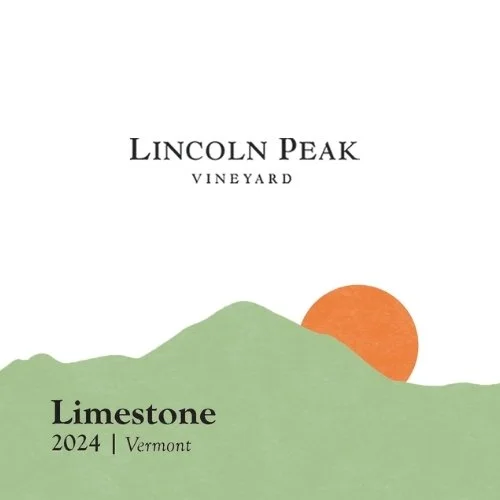
2024 Limestone ~ Release Notes


Vintage

After the warmest winter in Vermont history, the vines awoke just a bit earlier than normal but managed to avoid spring frost–a welcome correction from the devastating year prior. A very wet 2023 left plenty of water in the soil for the vines to get a quick start, growing vigorously in an otherwise warm, dry spring. Perfect weather during bloom and, perhaps, the vineyard’s determination to get back to growing grapes led to an excellent fruit set. Summer brought heat and humidity and, with it, disease pressure, making timely canopy management critical. In late August began a stretch of perfect weather with almost no rainfall until the end of September, allowing us to pick at peak ripeness all month long and into October. The 2024 vintage will be remembered for its abundance of fruit and for its wines of power and richness.

Vineyard

The Louise Swenson comes from two contiguous blocks planted in the Upper Vineyard in 2004 and trained to high-wire. The Lower Vineyard provides the Prairie Star and La Crescent, making this wine nearly a 50/50 blend of the two soil types.

Winemaking

Louise Swenson and Prairie Star were pressed whole cluster and cofermented, followed by regular bâttonage to build texture. La Crescent was destemmed and held on skins for 24 hours prior to pressing and arrested before the end of fermentation. This wine was later blended into the Louise and Prairie Star for juiciness and a oral lift. 100% stainless.

TASTING NOTES

Cut grass. Makrut lime. Minerality.

TECHNICAL INFORMATION

Harvest Date(s): 9/12/24, 9/23/24, 9/24/24
Composition: 48% Louise Swenson, 29% La Crescent, 23% Prairie Star
Alcohol: 11.6%
pH: 3.17
Titratable Acidity: 9.2 g/L
Residual Sugar: 5.1 g/L
Cases Produced: 56

Downloadable Technical Sheet

2024 La Crescent ~ Release Notes


VINTAGE

After the warmest winter in Vermont history, the vines awoke just a bit earlier than normal but managed to avoid spring frost–a welcome correction from the devastating year prior. A very wet 2023 left plenty of water in the soil for the vines to get a quick start, growing vigorously in an otherwise warm, dry spring. Perfect weather during bloom and, perhaps, the vineyard’s determination to get back to growing grapes led to an excellent fruit set. Summer brought heat and humidity and, with it, disease pressure, making timely canopy management critical. In late August began a stretch of perfect weather with almost no rainfall until the end of September, allowing us to pick at peak ripeness all month long and into October. The 2024 vintage will be remembered for its abundance of fruit and for its wines of power and richness.

VINEYARD

100% Lower Vineyard La Crescent. Planted in 2004 on 8’ x 13’ spacing and trained on Geneva Double Curtain, these are big vines with plenty of room to grow. And with the silty clays so typical of the Champlain Valley providing plenty of water and nutrients, oh boy, do they grow

WINEMAKING

The fruit we picked on the rst day was destemmed and held on its skins in the winery before being drained and pressed about 24 hours later. This juice was combined with the second day’s harvest, which was immediately pressed whole cluster. Fermented cold and slow, and arrested by chilling when we liked the balance. 100% stainless.

TASTING NOTES

Orange pith. White ower. Peach rings

TECHNICAL INFORMATION

Harvest Date(s): 9/23/24, 9/24/24
Composition: 100% La Crescent
Alcohol: 13.7%
pH: 3.24
Titratable Acidity: 10.0 g/L
Residual Sugar: 19.1 g/L
Cases Produced: 101

Downloadable Technical Sheet

2024 Black Sparrow ~ Release Notes


VINTAGE

After the warmest winter in Vermont history, the vines awoke just a bit earlier than normal but managed to avoid spring frost–a welcome correction from the devastating year prior. A very wet 2023 left plenty of water in the soil for the vines to get a quick start, growing vigorously in an otherwise warm, dry spring. Perfect weather during bloom and, perhaps, the vineyard’s determination to get back to growing grapes led to an excellent fruit set. Summer brought heat and humidity and, with it, disease pressure, making timely canopy management critical. In late August began a stretch of perfect weather with almost no rainfall until the end of September, allowing us to pick at peak ripeness all month long and into October. The 2024 vintage will be remembered for its abundance of fruit and for its wines of power and richness.

VINEYARD

Earlier pick La Crescent from the Lower Vineyard, specically the east side of the block. These vines are less vigorous so the fruit has more sun exposure and tends to ripen a bit earlier than elsewhere. Like the rest of the block, planted in 2004 in the silty clay of the Lower Vineyard and trained to Geneva Double Curtain.

WINEMAKING

Whole cluster pressed and fermented cold and slow before being arrested to retain as much fruity, oral character as possible. 100% stainless.

TASTING NOTES

Pineapple gummy bears. Lemon curd. Orange blossom.

TECHNICAL INFORMATION

Harvest Date(s): 9/16/24
Composition: 100% La Crescent
Alcohol: 11.5%
pH: 3.25
Titratable Acidity: 7.7 g/L
Residual Sugar: 27 g/L
Cases Produced: 50

Downloadable Technical Sheet

Our Farming Philosophy

A focus on sustainability and ecology through regenerative agriculture

Spring in Vermont is a time of life-giving warmth and color—a clear, compelling reminder of the importance of natural beauty on the human condition. Spring is also a time to act. To act upon lessons learned from the previous season, upon new farming plans formulated in the winter, and toward long term goals for the vineyard and the environment as a whole.

As stewards of this land, we place great emphasis on strengthening the natural world, using our knowledge and vitality to preserve its beauty and resilience. The tenants of regenerative agriculture are central to our practices in the vineyard, especially those that protect the soil and encourage biodiversity.

“The major distinguishing factor of the regenerative farming philosophy is the emphasis on restoration, which translates to a hyper-focus on topsoil and cover crops. By increasing biodiversity, improving the water cycle, enhancing the ecosystem, and supporting biosequestration, the regenerative farm strengthens the health of its own soil and increases the earth’s resilience to climate change.”

You’ll hear lots more about our farming philosophy in the future, but check out what we’re doing in the vineyard this spring to work toward our goals.

Last week we added three new members to our vineyard crew! Pruson, Foxy, and Wobbles are two month old Shropshire lambs from our neighbors at Werner Tree Farm. They’ll be hanging out with us this spring, grazing the vineyard floor, aerating the soil, and leaving behind some fertilizer.

Shropshires, once the most widespread sheep breed in Vermont, fell out of favor in the mid-20th century but are now making a comeback because of their use in regenerative agriculture. Their unique distaste for new shoots growing on woody plants makes them perfect for rotational grazing in both vineyards and tree farms, allowing farmers to maintain beneficial cover crops without the disruptive and damaging use of herbicide or tillage.

We also managed to get three new bat houses installed in the vineyard with a goal to grow our bat colony on the farm. Grape berry moth is a very real threat to our crop every year, and most farmers spray insecticide to help control populations and limit damage. Bats eat massive amounts of insects and we’re hoping that if we give them a nice place to sleep, they’ll help us protect our crop without using insecticides.

Ecological farming FTW!

Winter at the Vineyard

New Year, New Vine

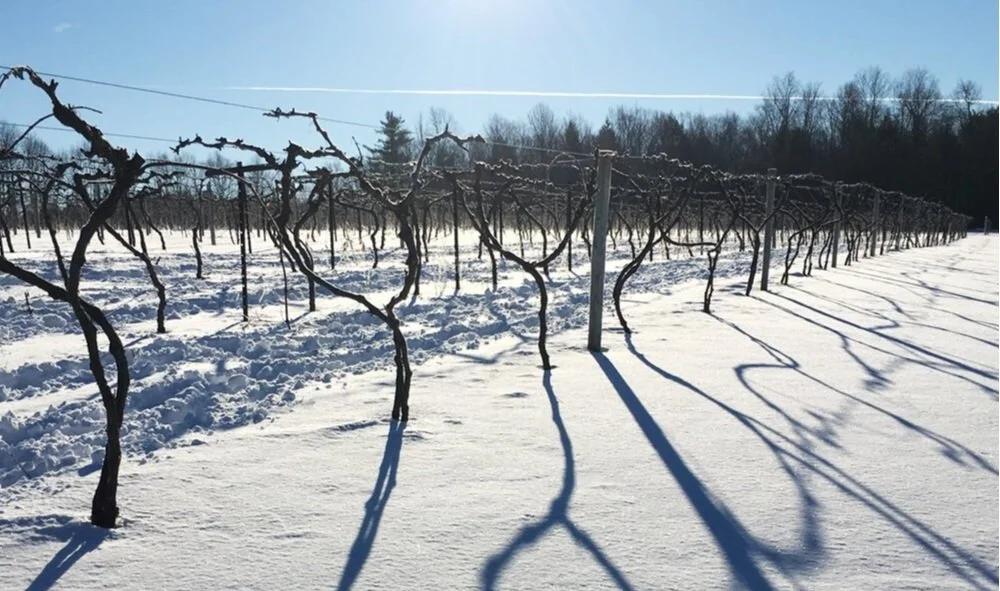
Snow has blanketed the vineyard and so far it’s been a beautiful, vintage Vermont winter. The sustained cold weather means the vines are now fully dormant, quietly recovering from the last growing season and eagerly preparing for the next. Dormancy also means that it’s time for one our favorite vineyard tasks of the year: pruning.

Pruning is like pressing a vine’s reset button, shedding the wood that laboriously produced last year’s harvest and making room for new growth. We may remove up to 90% of the vine’s wood every year, each cut strategically placed to maximize the plant’s potential and longevity. Nothing we do in the vineyard has a bigger, more lasting impact on the vine’s ability to fully and sustainably ripen fruit than pruning.

It’s not a glamorous process - maneuvering pruners with hands incapacitated by bulky gloves, unwrapping impossibly strong tendrils, and trying to avoid getting whipped in the frozen face by a rogue cane - but each vine is a unique and fascinating puzzle.

Without foliage to block our view, we can clearly see the vine’s structure and the clues it left us from the growing season. These clues - the length and thickness of a cane, the presence of a scar or stretch mark, the spacing between buds - help us decide what to cut away and what to retain. In this way, we can affect the shape of the vine, improve its immune system by redirecting sap flow away from damaged or diseased wood, encourage growth of a new trunk, and balance its vegetative (shoots, leaves, etc.) and reproductive (grapes!) potential.

Pruning is cold, hard work but its methodical nature and the quiet of winter make it a time for reflection, sharing stories, planning, catching up on podcasts, and discovering new music. The tracks in the snow remind us of the wildlife that share this land with us. And we stand in reverence of the vines, masters of regeneration and resilience.

Update from the Winery

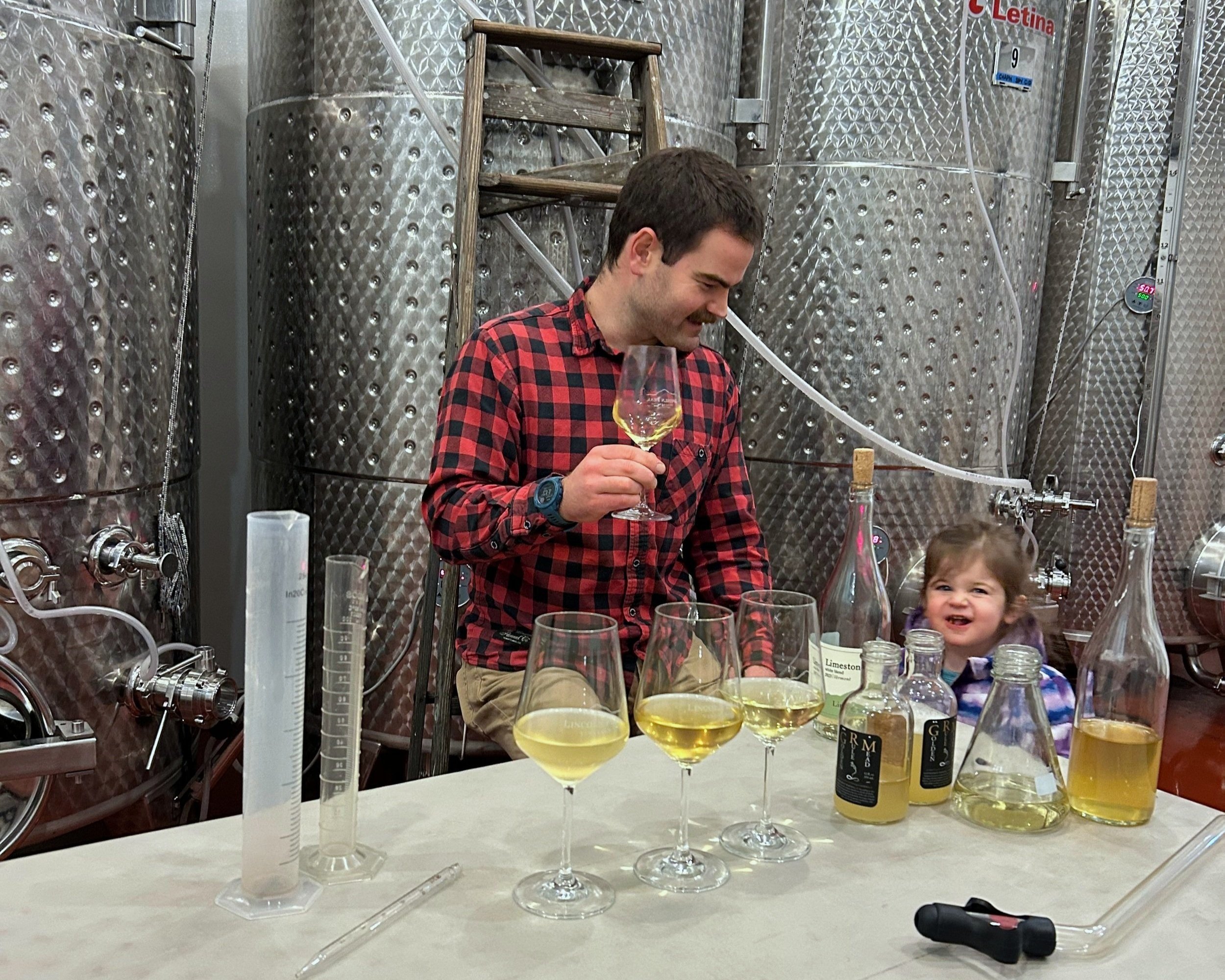
Kevin & Rosie sampling various blends of wines with beakers on a table in the winery.

Kevin and Rosie working on 2024 Limestone blends.
Taste. Discuss. Conceptualize. Blend. Taste. Discuss. Repeat.

Tis the season for blending

The darkest months of the year tend to be the slowest in the winery. It’s a rewarding and restful time for a winemaker; a time for reflection, planning, and lots of tasting.

As the yeast convert the last bits of sugar to alcohol, the ephemeral aromas of fermentation dissipate and the wines begin to clarify and take shape. This is when the nuances of the growing season and our practices in the vineyard and winery begin to reveal themselves.

The wines are still very young, especially the reds, but we can see more clearly than ever where they’ll go. Time alone will do most of the work, but there are a few techniques we can utilize in the cellar to pull the wines in one direction or another. These include careful oxygen exposure (or lack thereof), timely rackings, and bâttonage.

Most important, though, may be blending. The majority of wines that end up in our glass are a blend of different base wines from the cellar, carefully combined to build complexity, balance, and beauty. This, we think, is the most artistic aspect of winemaking.

Blending season kicks off with an early look at the new vintage of Limestone because the 2023 is almost sold out! We’re putting together bench blends with different proportions of Louise Swenson, Prairie Star, and two expressions of La Crescent. Teasing out flavors, popping aromatics, and building textures. It’s pretty fun. Grab some bottles of 2023 Limestone before they’re gone!

Winemaker Dinner Recap

Oh. What a Night.

This past Saturday we hosted 40 special guests for our very first Winemaker Dinner. We started in the tasting room with a grazing board loaded with local provisions before heading into the winery for a wonderful meal among the tanks and barrels. With the help of our friends at Dino Bones, it was a magical evening filled with delicious food, intriguing wine pairings, laughter, and thoughtful conversation.

Homegrown and handmade wines like ours have so many stories to tell, and these dinners are the perfect opportunity for us to explore each wine in detail and share its stories from the soil to our glass.

We’re already looking forward to the next one!